18 December 2025 - FBM Guest Lecture丨Global food supply chain resilience assessment: A case in the United Kingdom
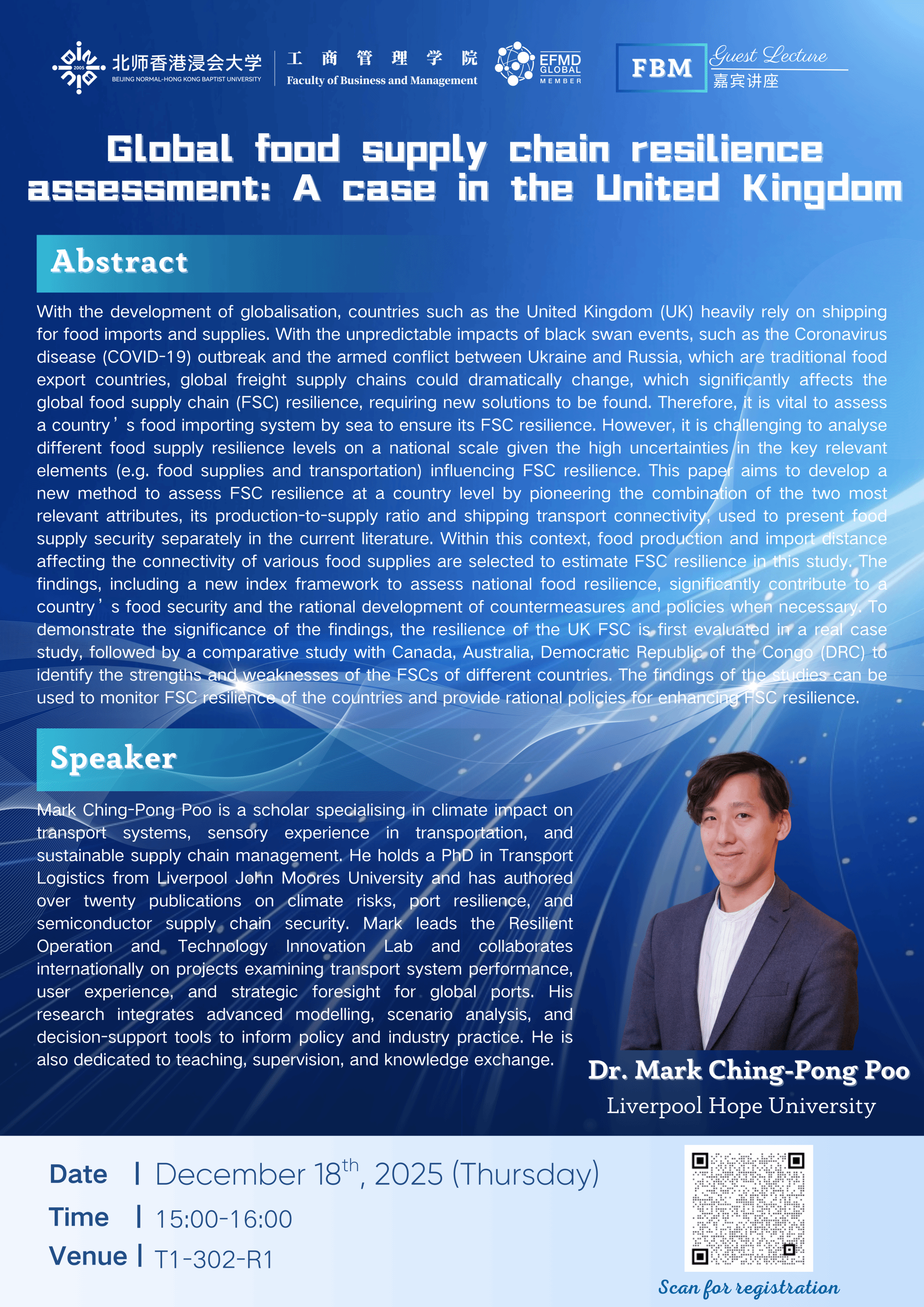
Topic: Global food supply chain resilience assessment: A case in the United Kingdom
Guest: Dr. Mark Ching-Pong Poo
Lecturer
Faculty of Business, Law and Criminology
Liverpool Hope Business School
Liverpool Hope University
Date: December 18th, 2025 (Thursday)
Time: 15:00 – 16:00
Venue: T1-302-R1
Language: English
Lecture mode: On-site participation
Abstract
With the development of globalisation, countries such as the United Kingdom (UK) heavily rely on shipping for food imports and supplies. With the unpredictable impacts of black swan events, such as the Coronavirus disease (COVID-19) outbreak and the armed conflict between Ukraine and Russia, which are traditional food export countries, global freight supply chains could dramatically change, which significantly affects the global food supply chain (FSC) resilience, requiring new solutions to be found. Therefore, it is vital to assess a country’s food importing system by sea to ensure its FSC resilience. However, it is challenging to analyse different food supply resilience levels on a national scale given the high uncertainties in the key relevant elements (e.g. food supplies and transportation) influencing FSC resilience. This paper aims to develop a new method to assess FSC resilience at a country level by pioneering the combination of the two most relevant attributes, its production-to-supply ratio and shipping transport connectivity, used to present food supply security separately in the current literature. Within this context, food production and import distance affecting the connectivity of various food supplies are selected to estimate FSC resilience in this study. The findings, including a new index framework to assess national food resilience, significantly contribute to a country’s food security and the rational development of countermeasures and policies when necessary. To demonstrate the significance of the findings, the resilience of the UK FSC is first evaluated in a real case study, followed by a comparative study with Canada, Australia, Democratic Republic of the Congo (DRC) to identify the strengths and weaknesses of the FSCs of different countries. The findings of the studies can be used to monitor FSC resilience of the countries and provide rational policies for enhancing FSC resilience.
About the Speaker
Mark Ching-Pong Poo is a scholar specialising in climate impact on transport systems, sensory experience in transportation, and sustainable supply chain management. He holds a PhD in Transport Logistics from Liverpool John Moores University and has authored over twenty publications on climate risks, port resilience, and semiconductor supply chain security. Mark leads the Resilient Operation and Technology Innovation Lab and collaborates internationally on projects examining transport system performance, user experience, and strategic foresight for global ports. His research integrates advanced modelling, scenario analysis, and decision-support tools to inform policy and industry practice. He is also dedicated to teaching, supervision, and knowledge exchange.


